A Non-Monetary Incentive Mechanism for Mobile and Spatial Crowdsourcing Task Assignment

Background
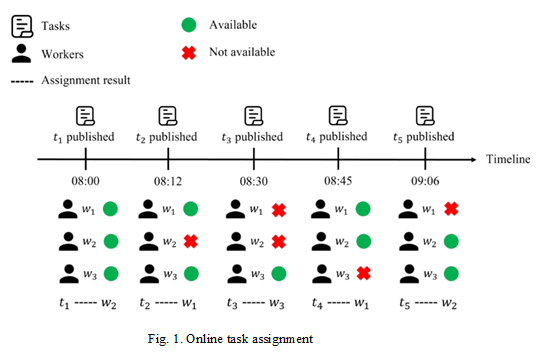
Crowdsourcing harnesses the collective effort of many participants and underpins today's gig economy, from ride-hailing (Uber) to food delivery (Uber Eats, foodpanda). In mobile and spatial crowdsourcing, a platform must assign location- and time-constrained tasks to suitable workers in real time (Fig. 1). This problem is NP-hard and faces three challenges: heterogeneous worker quality, long travel distances that reduce efficiency, and a lack of effective incentives that discourages participation. Most existing studies consider either spatio-temporal factors or worker reliability, but not both, and their incentives are almost entirely monetary.
Method
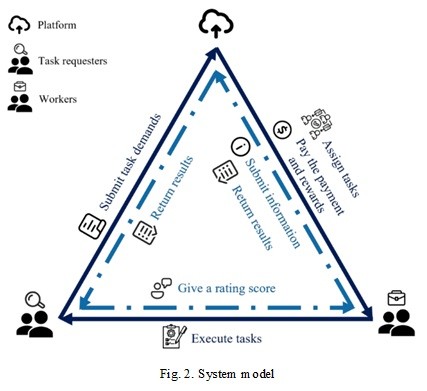
We propose STA-NIM, a suitability-based task assignment framework with a non-monetary incentive mechanism. Its system model, shown in Fig. 2, has four components:
(1) Reliability evaluation: a fuzzy inference system with 27 rules infers each worker's reliability from task completion rate, task pass rate, and rating score.
(2) Suitability calculation: suitability jointly considers worker reliability and task-worker distance, combining a fuzzy inference system with the entropy weight method. The framework switches between the two based on the weight ratio of the indicators: fuzzy inference keeps results stable when the weights are similar, while the entropy weight method separates candidates objectively when they differ. When a task is published, available workers are filtered by task radius and workload limit, and the task goes to the worker with the highest suitability, in O(|W|) time.
(3) Monetary incentive: payment is based on reliability, travel distance, and completion time, with factor weights set by linear programming so that payment never exceeds the task budget.
(4) Non-monetary incentive: in each cycle, a worker's rating and completion efficiency are quantified as a "power" value. Workers who perform well receive extra task quota, and therefore more earnings, in the next cycle. A Gini-coefficient constraint keeps tasks from concentrating on a few workers.
Results
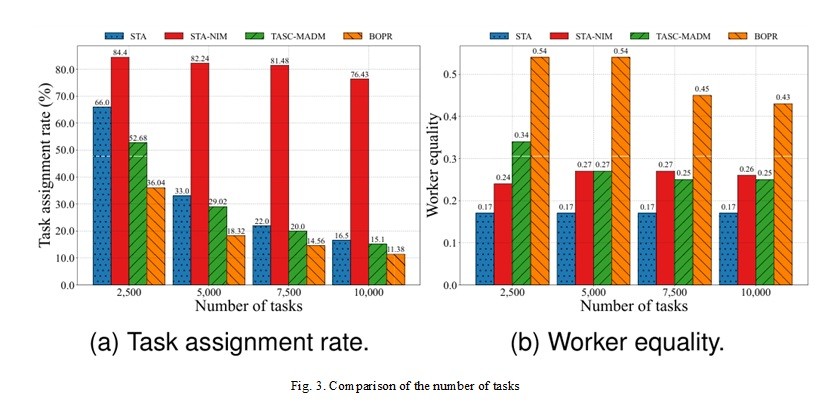
Using a semi-synthetic dataset built from Foursquare, Yelp, and Kaggle data, we compared STA-NIM with STA (no non-monetary incentive), TASC-MADM, and BOPR:
(1) From 2,500 to 10,000 tasks, STA-NIM's assignment rate stays above 76%, with the smallest decline (2.16%-7.97%; Fig. 3).
(2) STA-NIM keeps a high assignment rate with fewer workers, doing more with less.
(3) As the basic workload rises, STA-NIM's Gini coefficient falls, spreading tasks more evenly; the other methods become less even.
(4) STA-NIM yields the highest average worker payment, rising 7.14%-42.9% with the budget.
(5) STA-NIM achieves the highest average reliability at a moderate travel distance, with a maximum execution time under 375 ms, fast enough for real-time use.
Contributions and Future Work
STA-NIM balances task quality, efficiency, and fairness, and rewards high-performing workers with more opportunities and income. It can be applied to food delivery, ride-hailing, crowdsensing, and smart-city data collection. Future work will add task reassignment for worker drop-outs, handle the cold-start problem for new workers, and use game-theoretic analysis to address strategic behavior.
Providede by the Data Management Lab, Department of Computer Science and Information Engineering / Advanced Institute of Manufacturing with High-tech Innovations (AIM-HI), National Chung Cheng University
Hao-Cheng Zhang and Yu-Ling Hsueh, “A Non-Monetary Incentive Mechanism for Mobile and Spatial Crowdsourcing Task Assignment,” IEEE Transactions on Services Computing (TSC), No. 1, Pages 1-15, 2026. (SCIE; Impact Factor:5.8; Rank:11/129 in Computer Science, Software Engineering; Q1)
https://doi.ieeecomputersociety.org/10.1109/TMC.2026.3708376
Recommended Reading
-
Deep-Learning Technique for Bed-exit Action Prediction of Elderly Using Extremely Low-resolution Thermopile Sensor Array
Mar 01 , 2025 -
Security and Privacy for 6G: A Survey on Prospective Technologies and Challenges
Jul 14 , 2025 -

Outstanding Young Scholar Spotlight: Associate Professor Jian-Jhih Kuo
Sep 18 , 2025 -
Critical analysis of the technological affordances, challenges and future directions of Generative AI in education: a systematic review
Sep 18 , 2025